Headcount planning may be one of the most important decisions a revenue organization makes — and one of the least standardized. At most companies, it’s an annual ritual that blends finance targets, sales ambition, historical budgets, and whatever hiring velocity HR believes is realistic.
Despite all the meetings, spreadsheets, and alignment exercises, the same questions linger every year:
Are we hiring too aggressively, or not enough?
Will these reps ramp in time to matter?
How much capacity do we really have next quarter?
And why does every team seem to have a different answer?
The problem isn’t intelligence or effort. It’s that most companies are using a planning model designed for a world that no longer exists.
High-performing teams now use a completely different approach — one that models capacity as a system, not headcount as a line item.
Here’s how that shift works.
Headcount is static. Capacity is dynamic. Plan for the dynamic.
Traditional models assume headcount is a proxy for output. If the team grows from 80 AEs to 95 AEs, capacity is expected to rise accordingly.
But modern revenue orgs have more dynamic variables than ever:
variable ramp curves across segments
uneven productivity by tenure
hybrid territories
ramp reset after role changes
attrition volatility
specialization (SDRs, AMs, overlay teams)
Static headcount targets can't capture this complexity. That’s why high-performing teams stop asking “How many reps should we have?” and start asking “How much capacity do we actually have available to produce revenue?”
To answer that, they model ramped-rep equivalents, expected attrition, time-to-fill, seasonal productivity shifts, cohort trends, and recovery timelines.
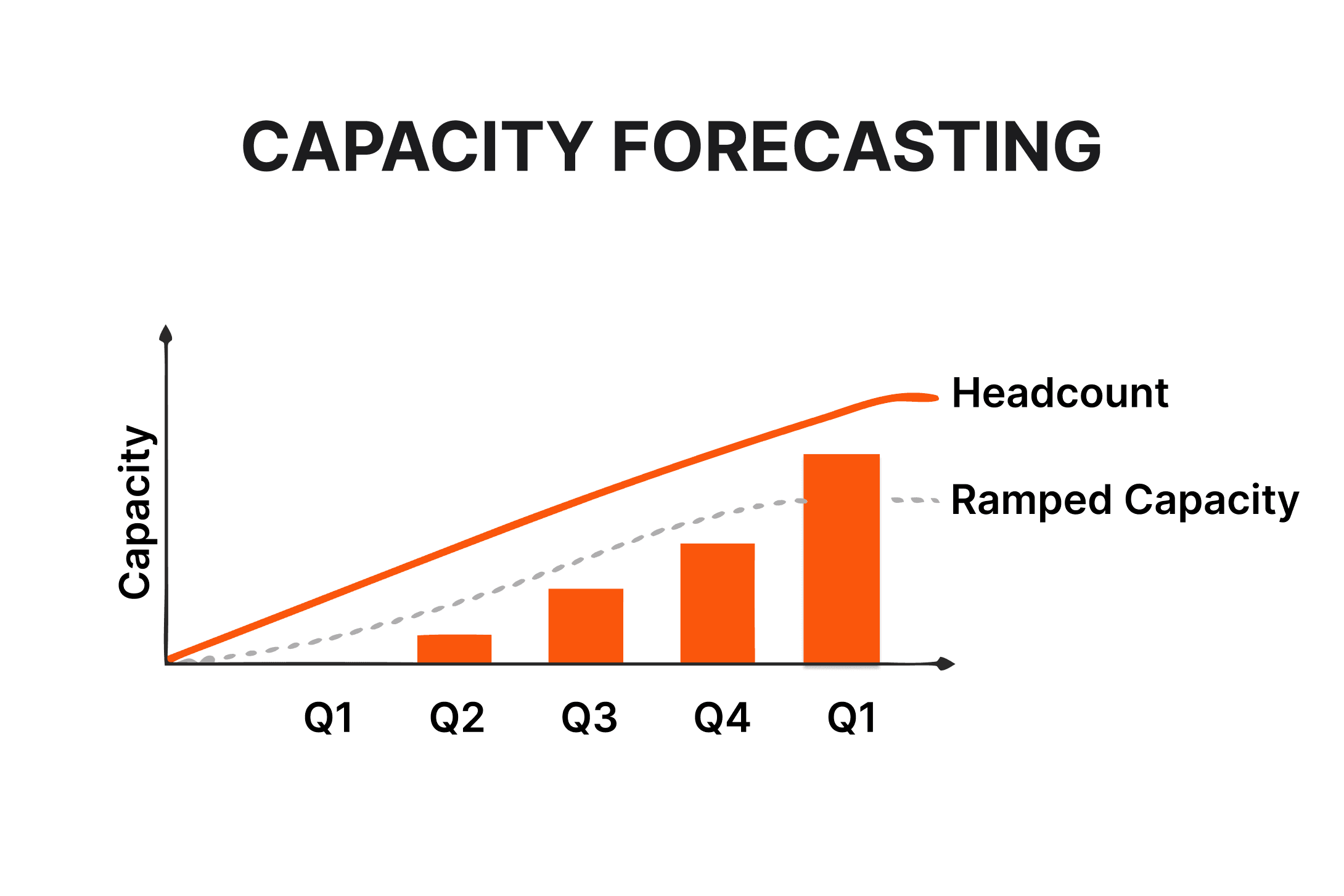
Planning to headcount assumes every rep is fully productive. Planning to capacity reveals the real ramp curve that determines revenue.
Annual planning is the least reliable way to forecast
In most companies, headcount planning happens once a year: sales forecasts growth, finance backs into a hiring plan, HR submits targets, and everyone agrees to “stretch goals.”
But annual planning rarely survives contact with reality. Even small deviations such as a hiring delay, territory redesign, or marketing miss, can compound fast; leaving gaps that ripple through the forecast.
High-performing teams avoid this trap by treating headcount planning as continuous, not annual. They update capacity models monthly or even weekly, connecting live data across HRIS, ATS, and CRM systems.
The result: planning becomes a rolling forecast, not a frozen document.
The best teams run headcount planning like scenario modeling, not budgeting
Most companies build one plan.
High-performing teams build three and learn from all of them.
Scenario A — Expected case
Based on real hiring velocity, historical ramp, typical attrition.
Scenario B — Risk case
Accounts for hiring slippage, slower cohort performance, seasonal productivity dips.
Scenario C — Growth case
Used when investments accelerate or new markets open.
Instead of arguing about which “plan” is correct, stakeholders align on:
“What happens under each scenario — and how do we prepare for it?”
This shifts the conversation from defensive (budget policing) to strategic (risk planning).
The real work isn’t headcount planning — it’s organizational alignment
Companies often assume headcount planning is a math problem. In reality, it’s a coordination problem.
Sales knows expected quota performance
Finance knows budget constraints
HR knows hiring velocity
RevOps knows the operational model
Each owns a different piece of the truth — and when those systems don’t sync, alignment breaks down.
High-performing teams fix this by building one shared data model, one shared ramp definition, one shared view of hiring progress, and one shared forecast of capacity recovery. Alignment doesn’t come from meetings. It comes from a unified model.
No more “Rep Ramp = Three Months” — replace assumptions with observations
Many companies still rely on rule-of-thumb ramp curves:
30% at 30 days
60% at 60 days
100% at 90 days
Cohort-level analysis usually reveals slower enterprise ramps, spikier SDR productivity, and higher volatility in months 4–6 depending on enablement quality.
High-performing teams measure ramp, not assume it. The result? Forecast errors drop by 10–25%, quota accuracy improves, and hiring targets become data-driven. Ramp accuracy turns into one of the biggest levers in the planning engine.
Attrition isn’t an HR problem — it’s a planning input
Traditional models treat attrition as accidental, unpredictable, and external.
High-performing teams treat attrition as a capacity factor with structural patterns:
disengagement often begins 30–60 days before resignation
high-performers create longer recovery gaps
internal transfers behave like partial attrition
poor onboarding accelerates first-year exits
delayed hiring amplifies downstream effects
When attrition is modeled as a timeline rather than an event, headcount planning stops reacting to churn and starts preparing for it.
Predictable models replace reactive surprises.
The most mature teams use a “capacity recovery timeline” as their north star
Instead of asking:
“When will this role be filled?”
They ask:
“When will this seat be productive again?”
This is a fundamentally different question — and it leads to fundamentally better decisions.
Capacity recovery accounts for:
time to open
time to hire
time to onboard
time to ramp
time to reach quota consistency
Once teams begin forecasting recovery instead of replacement, they can finally see the real impact of hiring plans and attrition.
The shift: from headcount planning to a capacity operating system
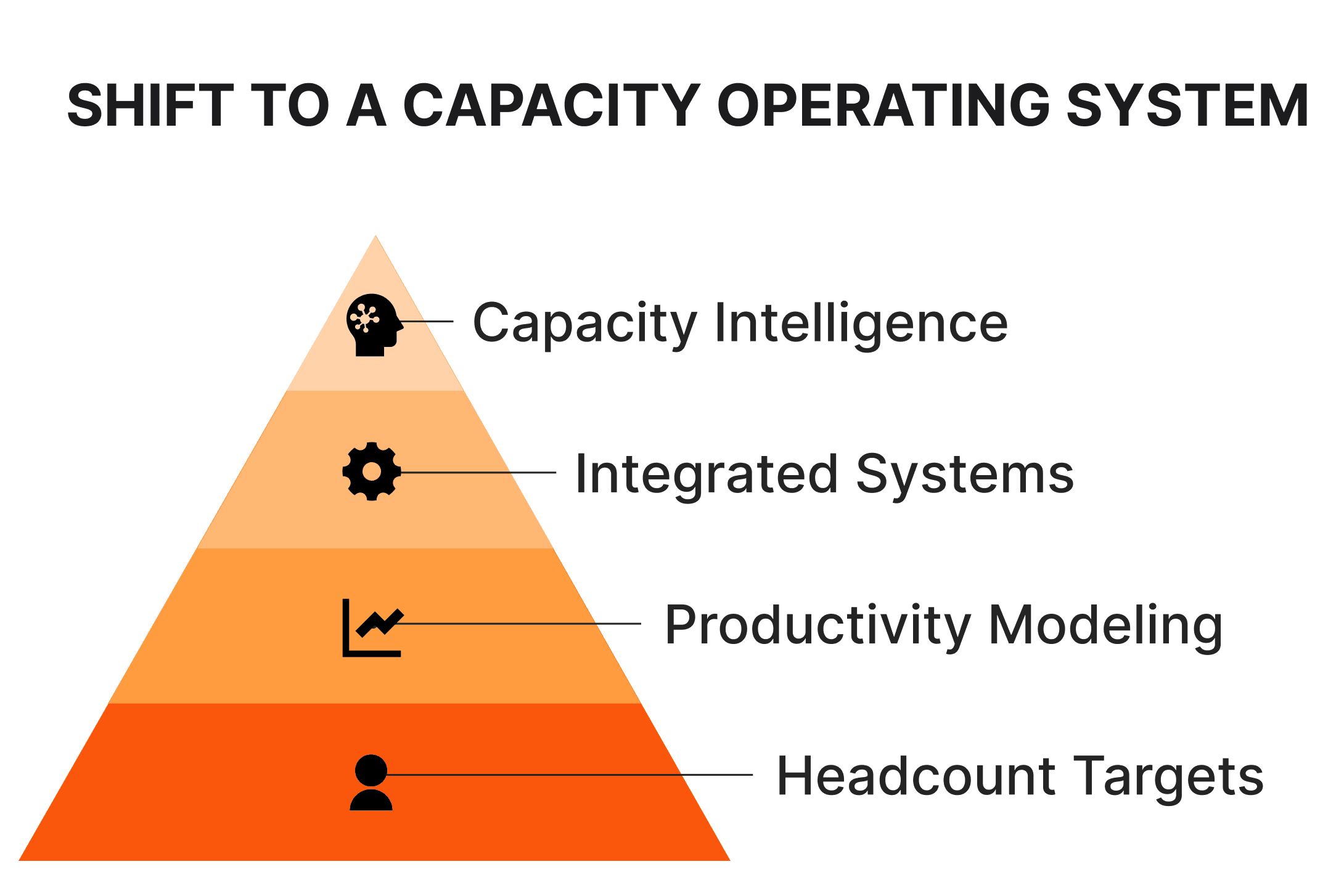
Most organizations start with Headcount Planning — counting reps, not productivity. It’s a necessary baseline, but it leaves too much hidden beneath the surface.
Next comes Productivity Modeling, where teams begin to connect roles, ramp, and quota. It’s progress, but still limited by manual updates and siloed data.
Integrated Systems mark the turning point; when HR, Finance, and RevOps finally speak the same language. One model, shared assumptions, live visibility.
The highest-performing teams operate with Capacity Intelligence — a dynamic, always-on model that reflects real-time selling power. It’s the difference between reacting to reality and modeling it.
This is the evolution every revenue team should strive toward: from static headcount to continuous capacity insight.